
The management accounting syllabus and course structure is based on the South African Institute of Chartered Accountant (SAICA) competency framework.
Me and my fellow colleagues engage with SAICA on a yearly basis, by providing recommendations and suggestions on the competency framework, based on our experience in class on different topics. As subject head of Management Accounting 378, I work closely with the subject head of Management Accounting 278 and 778 to provide SAICA with constructive feedback. Annually, I also take part in an exercise where SAICA is provided with feedback on the board examinations (ITC – Initial Test of Competence) written by our alumni students. I comment on the topics presented by myself. Being part of this engagement with SAICA has provided me will valuable insight and knowledge on the syllabus and expectations from practice. Yearly, when I reflect on the engagement with SAICA, I amend and improve our syllabus and my teaching style to provide students with the best form of education and to really incorporate changes in the course. By being part of feedback on board examinations, I have learned the ways in which practical application of basic principles of management accounting are tested and provided me with the skill-set to also test in similar ways. Term tests set by me follow the same framework and basis:
-
- Example of term test – My teaching philosophy strives to provide students with visual presentation and practical relevance of the syllabus, which I try to incorporate in tests and examinations by setting scenarios that are based on real-life businesses. This test question set by myself required the application of basic principles on a real-life scenario and was based on the CBC brewing company in Paarl, specifically the manufacturing of a CBC Pilsner beer.
- A feedback session was also scheduled a few weeks after the test in which the practical relevance of the scenario of the question was discussed. The session furthered to include a message (video below) from the master brewer of CBC brewery, in which he introduces the actual Pilsner beer on which the question was based. The purpose of showing this video in class was to show students the reality of the processes with which they are dealing in the course. Video by the master brewer of Cape Brewing Company (CBC):
The syllabus and course structure
- SAICA Competency framework (extract only) – (parts relating to only the area I teach in, namely management, decision-making and control)
- Competency mapping of MDC – MDC (management, decision making and control) is one part of the syllabus and also the part that I am lecturing. A mapping is done annually between the syllabus and the courses to ensure that all the outcomes are covered in our course. As subject head of Management Accounting 378, this is my responsibility.
- FM (financial management) is the second part of the syllabus, but covers an area in which I currently do not teach. A similar mapping to the MDC-mapping is done annually to ensure that all the outcomes are covered in our course. As subject head of Management Accounting 378, this is my responsibility.
- Pervasive Skills mapping – As part of our course and the SAICA syllabus, one of the requirements are to develop pervasive skills of students. A mapping is done annually between the pervasive skills and the area in the course where we try to develop these skills. One example is the development of the skill to effectively work together in groups – refer to the new initiatives tab for an example of the group work done to develop this skill.
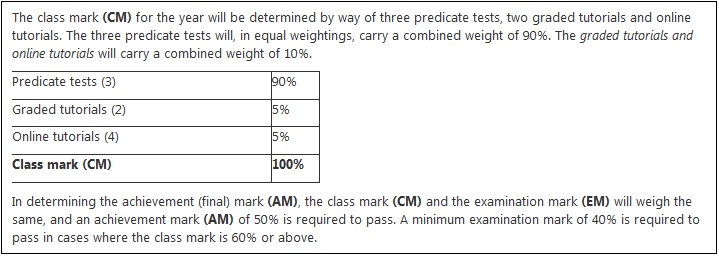
- The module framework and course information are readily available to students on SUNLearn, the student platform of Stellenbosch University. The calculation of class and final marks are:
Sample course material
All my course material is directly linked with the SAICA competency framework. MDC course material for each topic, developed and maintained by me, for Management Accounting 378, consists mainly out of:
- Notes and question pack – Notes typically contain the section of the SAICA competency framework that relates to the topic presented, class notes on important principles and a question pack – sample notes for topic: Variance analysis (extract of flow only)
- Questions and solutions are divided into:
- Class examples – testing basic principles
- Individual Learning Programme (ILP) questions – testing basic principles from a practical angle in separate ILP lectures.
- Tutorial questions – higher-level questions testing basic principles in real-life scenarios; these questions are done in formal tutorial classes
- Application questions – higher-level questions used in application classes to teach examination and problem-solving techniques
- Exercise questions – additional higher-level questions provided to students in order to practise the high-level application of principles under test and examination conditions
- For detailed explanations on the types of questions found in question packs, refer to the new initiatives section of this portfolio.
- Questions and solutions are divided into:
- Presentation slides used during lectures to showcase teaching philosophy of visualise, understand and apply. – sample slides for topic: Variance analysis (extract only)
 William Arthur Bishop