
Teaching the ability to apply basic principles is one component of my teaching philosophy. After reflecting on my 2013 student feedback, I realised that students were finding it difficult to overcome the 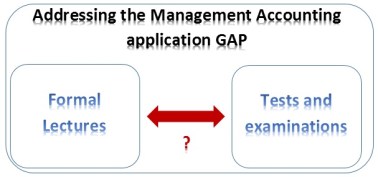 gap between formal lectures and tests and examinations. Students were able to study the theory and basic principles, but the moment they are asked to apply these principles in a practical scenario in a test or examination, the skill to apply the principle was not there (application). In 2014, I started to introduce additional higher-level application exercises to students through which they could learn the skill to apply. I also amended my teaching style to focus on both the basic principle and the application thereof in a practical scenario.In January 2015, I extended the above-mentioned approach by formally implementing the following in the Management Accounting 378 course:
Application classes: I amended the content of formal lectures to include an application class. The last lecture period of a specific topic will typically be presented as the application class. During these lectures, focus is placed on the application of the principles that were taught in the normal lectures by means of class examples. A more complex and practical case study is used during these sessions to teach students how to deal with basic principles in a practical scenario. Focus is also placed on examination technique during these lectures.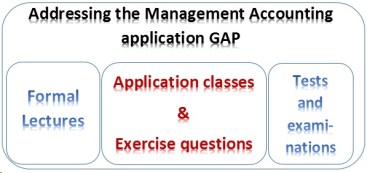
Exercise questions: After the application class, another complex and practical case study is provided to students, formally known by students as the ‘exercise questions’. The solutions to these questions are kept from students for an entire week. The purpose of these questions is to provide students with more complex case study-type questions that ought to be done by students under test and examination conditions, after basic principles were studied. Students are encouraged to create a space where they can complete these questions under examination conditions (i.e. without the solution and completion within the given time-frame). The solutions are then released to students on the electronic student platform (SUNLearn) a week after the exercise questions were made available.
These initiatives are proving to be successful after reflecting on positive feedback received from students in 2015 and 2016 as well as an increase in the pass rate of Management Accounting 378 since 2014.
Online tutorials and group project
The competency framework of SAICA that forms the basis of the Management Accounting module framework also requires of students to develop pervasive skills. Consequently we implemented online tutorials and a group project to expose students to platforms that will assist them in the development of some of these pervasive skills.
Online tutorials: The online tutorials were developed to provide students with exposure to IT-related learning and were implemented by me in Management Accounting 278 in 2014, in Management Accounting 378 in 2015 and in Management Accounting 778 in 2016. Most of these online tutorials are based on a practical scenario or case study that students have to read through before answering the online questions. This format was developed so that students are still exposed to practical scenarios as required by my teaching philosophy of applying basic principles on practical scenarios.
- One example is where my students had to work through a practical scenario before answering online questions, all based on the same scenario. This tutorial encourages students to work through a scenario first in order to understand (visualise and understand), before attempting the questions (apply).
Group project: In 2015 one of my colleagues and I also developed a group project for Management Accounting 278 and 378 students in which they were required to draw up a business plan for a business of their choice. To enhance the use of tools other than just Word documents, we designed the project to contain three components, namely an executive summary in the form of a video, strategic and other information to be presented in PowerPoint (or any other presentation tool of their choice) and an Excel document with calculated forecasts to teach the skill of working with spreadsheets. Deliverables were all submitted and all grading was done via the SUNLearn student platform. Since 2015, this project is done annually in the 278 course and counts towards 10% of the total class mark.
An example of one of the videos made by one of the student groups can be viewed here:
Interaction on social media
The importance of social media in the lives of our students is something that cannot be ignored. I realised that one of the best ways to effectively communicate with students is through social media platforms. In January 2014, I opened a Facebook group for Management Accounting 378. This page is used to communicate important information and news to students, but also to encourage students to share and discuss management accounting related topics. By sharing relevant videos on management accounting topics, my teaching philosophy of visualisation is achieved. My student feedback in 2016 also reflected an appreciation for accessibility to students with a score of 4.7 out of 5. An example of Facebook interaction with students:


Yearly I reflect on the new initiatives discussed above, as well as student feedback, in order to enhance the course structure of Management Accounting 378. The following section details how my teaching style and new initiatives were incorporated in the course structure.
 William Arthur Bishop