My field of teaching lies within management accounting, more specifically cost management, management decision making and control and risk management, which are all sub-categories of management accounting. I teach both undergraduate and postgraduate students who study towards becoming registered chartered accountants of South Africa.
My undergraduate teaching involves explaining basic management accounting principles and their application in real-life scenarios to final graduate students (Management Accounting 378). My postgraduate teaching mainly involves the higher-level application of basic principles taught in undergraduate studies and problem solving.
Through my reflection on student feedback received from 2013, both in undergraduate and in postgraduate teaching, a very clear need was identified to bridge the gap between teaching the basic principle and its higher-level application to real-life scenarios. I have therefore made it my main goal to develop and provide a teaching environment in which students can visualise, understand and apply in order to learn. I do this through transmission and developmental teaching perspectives (Teaching Perspectives Inventory, 2017). Through transmission I transfer the required content to students by using different visual teaching techniques, as can be seen in the teaching style and practice section of this portfolio. Through developmental teaching I develop the skills to apply basic principles in higher level scenarios, as can be seen in the new initiatives part of this portfolio. This forms the core of my teaching philosophy.
Visualising management accounting makes it alive and practical.
Visualisation –  I firmly believe that learning basic management accounting principles by means of memorisation is a means to failure. Management accounting principles were developed over the years from real business results and should be visualised and understood, rather than learned off by heart. I therefore make use of videos, pictures, concept maps (Ericson, 2015), real-life scenarios and newspaper articles as part of my teaching style to show students where the basic principles come from. In a study done by Ngwakwe (2015), it was concluded that video presentations of real-life practice of management accounting may have a positive effect on students’ understanding of basic management accounting principles and even on their performance. I also make use of my iPad during lectures to provide students with better visual presentations. As soon as students can visualise the background of a principle, understanding the principle itself becomes second nature. Examples of my teaching style are showcased in the teaching style and practice section.
Understanding – Once students can visualise basic management accounting principles, it becomes easier to understand the work (Ngwakwe, 2015). Properly understanding the work comes with practice. My teaching style therefore involves a step-by-step approach in which I start with easy examples and build on them in order to reach the required level of knowledge skill. I provide students with class examples that are on an easy level to ensure that the principle is understood. In class I ensure that all students understand through interaction and re-explaining concepts. I also ensure that I always explain in such a way that the average student ought to understand – getting this right came with practice. During class I encourage students to think with me and not only to listen to me. I believe that through communication, understanding becomes easier. I therefore create times in my lectures in which I ask students to sit back and talk to their fellow students about difficult concepts. This helps them understand principles better.
Application – My step-by-step teaching technique, as discussed above, starts with basic class examples to learn the basis of principles. These are however not sufficient to pass a test or examination, as Management Accounting is an application subject. I have realised this through reflection on student feedback over the past few years. Students indicated that they find the tests and examinations more difficult than the examples of basic principles learned in class. My lectures are therefore structured in such a way that I build on the class examples in the form of application and tutorial classes (for more on the development of my teaching style, refer to the new initiatives page). Application classes are lectures in which I take a real-life scenario-type of question and map it against the basic principles learned. The main focus of these lectures is the proper reading of scenarios, extracting relevant information and applying it in building a solution to the question. I therefore teach students how to read efficiently in order to identify the important concepts that are required to answer the question. I focus strongly on examination technique, namely how to extract information from a real-life scenario and apply it in answering a high-level question. Sometimes the questions in Management Accounting can reach six pages of writing. Consequently, it is essential that students know how to deal with these lengthy questions, extract information and apply it in building a solution. Further to application classes, tutorials are also scheduled in which students can practise the application of basic principles in questions. I therefore always ensure that tutorial questions have real-life scenarios in which application can be practised satisfactorily.
I have had great success in my teaching philosophy over the last couple of years, as reflected in the student feedback, both formal and informal, on my teaching style and new initiatives I have implemented. I however also believe that a philosophy can never be stationary. I therefore constantly reflect on student feedback and strive to improve on my philosophy by fine-tuning my technique and trying to find areas in the course that can be improved on and better explained. In the new initiatives section of my portfolio, I showcase how my teaching style and practice have been developed over the years. I am actively developing myself by always looking at better teaching techniques, attending workshops and sharing styles with other lecturers.
My main goal as a teacher is to always ensure that Management Accounting is a subject that students enjoy, where students can learn through visualisation and where students are empowered with skills that they can apply in their future profession.
Formal application of my teaching philosophy
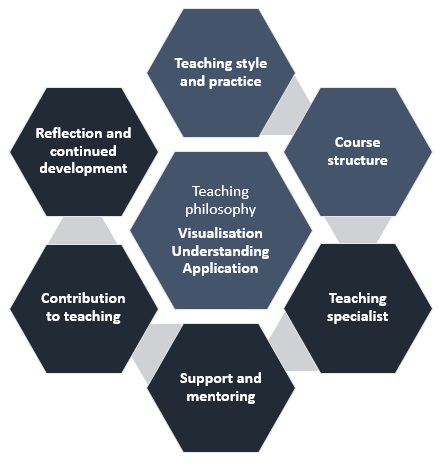
My teaching philosophy flows through everything I do and is actively applied through different components of my practice and showcased in this portfolio in the following pages:
- Teaching philosophy – In this section of my portfolio, the core of my teaching philosophy is discussed and further described by the teaching style and practice I follow, new initiatives I implement to ensure that my teaching philosophy is applied through my teaching and the influence my teaching philosophy has on the development of my course structure.
- Teaching specialist – My teaching philosophy requires of me to be a specialist in my field through constant revision of my teaching style in order to provide the best teaching environment to my students. For this I attend courses for my own development and ensure that I always use the newest teaching techniques in my classes. I also do research in the field of my teaching to provide me with the opportunity to be an expert in my field. Further to this, I am involved in internal and external moderation of other Management Accounting courses to share my expertise, as well as self development.
- Support – I am involved in mentoring students and actively providing students with feedback so that they can learn from their mistakes and improve the skill to apply basic principles, as required by my teaching philosophy. Further to this I am involved in mentoring and support programmes to assist students who struggle with the understanding and application of management accounting principles.
- Contribution to teaching – I share my teaching style with other lecturers in order to contribute in building a management accounting learning culture in which students can learn through new technologies and visualisation. My teaching philosophy will fail if I do not allow other lecturers to follow my lead and expose my philosophy to all students of the faculty.
- Reflection and continued development – Feedback received from students, the Management Accounting 378 pass rate history and achievements I have reached over the last four years illustrate the success I am currently having with the application of my teaching philosophy and allows me to reflect and continually improve on my teaching philosophy, style, practice and course structure.
In the sections to follow, a discussion of each one of these components of my teaching philosophy will be discussed.
References
- Teaching Perspectives Inventory. (2017). The Five Perspectives. http://www.teachingperspectives.com/tpi/
- Ericson R, (2015). Gen en to grad school: Three teaching techniques that work across different disciplines, learning platforms, and level of instruction, http://journals.gmu.edu/ITLCP/article/view/623
- Ngwakwe CC, (2015). Industry real-life management accounting practice: A differential effect on accounting students’ performance. South African Journal of Higher Education 29(3): 69-86. http://journals.co.za/content/high/29/3/EJC176236
*Pictures used in this portfolio were obtained free from Pexels.com. Copyright clearance.
*Links to website only contains one pagers of the abstracts of the articles/content referred to in my philosophy
 William Arthur Bishop