Visualisation, understanding and application are the core focus of my teaching philosophy and therefore my teaching style goes beyond only transferring information to students. I make use of many examples from practice to transfer the knowledge of practical application to students and make it easier for them to understand the content. To do this, I use a variety of electronic techniques:
Use of videos: I use videos of real businesses and link these to the academic content of the syllabus so that students can visually see the processes of the business. To do this, I edit videos through Camtasia to make it relevant to the respective topic being lectured. Attending a blended learning course through the University of Stellenbosch has helped me to gain this skill. Student feedback over the years have also reflected that my teaching style is technologically innovative.
An example of a video that was used by me as a teaching tool to provide a visual understanding and practical application of basic management accounting principles, included in the course syllabus, on the chocolate-manufacturing process.
(source of original video: https://www.youtube.com/watch?v=9uuVuQKPdeU)
Disclaimer: This video was originally presented with Afrikaans narrations, but was translated for the purpose of compiling this portfolio.
Group discussions: I sometimes make use of group discussions in class on actual business scenarios familiar to students. Both my 2015 and 2016 student feedback reflected a score of 4.5 out of 5 for encouraging students to participate in the model.
An example of a group discussion
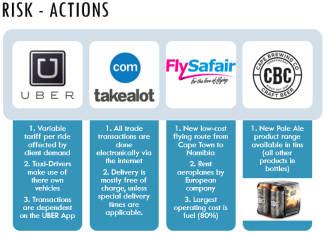
Yearly when I teach the Management Accounting topic Risk Management, the class is divided into four blocks, each block being assigned a business (Uber, Takelot, FlySafair or CBC). Students are then, in smaller groups, asked to identify business risks and actions that they could put in place to address these business risks. Some of these risks and actions are then presented and discussed with the entire class.
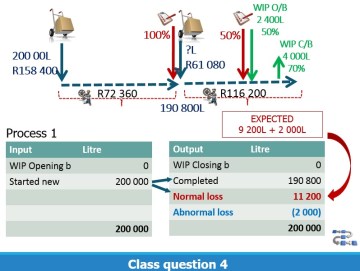
Explanation through pictures and diagrams: I have noticed over the years that pictures and diagrams are better forms of explaining principles, rather than only text and figures. When students can see the components, they tend to understand the concepts better. Through reflection on student feedback received over the last few years, students have indicated that my explanations and simplification of difficult concepts are extremely helpful.
Example of pictures used in lecture slides to explain how a manufacturing process works and which cost components form part of the cost calculation are as follows:
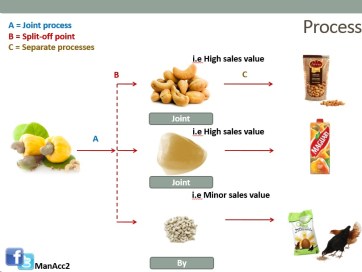
 Example of pictures and diagrams used to explain the basic principles behind joint and by products, using the real-life Cashew nut, fruit and fruit juice manufacturing process as a visual example:
You-tube video showed in class before the slides was presented, to provide a visual understanding of the cashew nut, fruit and fruit juice process:
The power of two screens: In all my lectures I make use of two screens in order to enhance the visual qualities of my presentations. On the one screen, I present content from the instructor PC, while on the other screen I present content loaded on my iPad. Student feedback has indicated that students appreciate the two screens and that this is an area of my teaching style that needs to be maintained. For more on using an iPad during lectures, refer to the section on sharing my teaching style. An example of the two screens used in one of my lectures are as follows – iPad content on the left and PC content on the right:


Keeping my teaching style fresh and new through reflection: Due to the absolute love I have for teaching, I also have this desire to always improve, refresh and develop my teaching style. Each year I revisit my course material, content, teaching style and student feedback and identify areas for improvement. In 2013 and 2014, student feedback reflected that students are finding it difficult to link class examples and content to tests and examinations. Some of the improvements I have made over the past four years to both my teaching style and the course structure as a result of feedback received from students are show-cased in the next section of my portfolio, new initiatives.
 William Arthur Bishop